For many customers in Pakistan, a new smartphone is only affordable on installments (qist). Shops that offer installment plans sell more phones — but they also carry risk. A notebook full of plans, slips in a drawer and reminders kept in someone's memory is how money gets lost. This guide shows how to run installment sales with clear rules and the right records.
1. Decide your installment policy first
Write down your rules before you offer the first plan, and apply them to everyone:
- Minimum advance: a meaningful first payment (many shops ask for a third or more of the price).
- Maximum duration: shorter plans (3–6 months) are easier to recover than long ones.
- Documents: CNIC copy, a working mobile number, address and — for larger amounts — a guarantor.
- Late payment rule: what happens if a payment is late, explained at the time of sale.
2. Record every plan properly
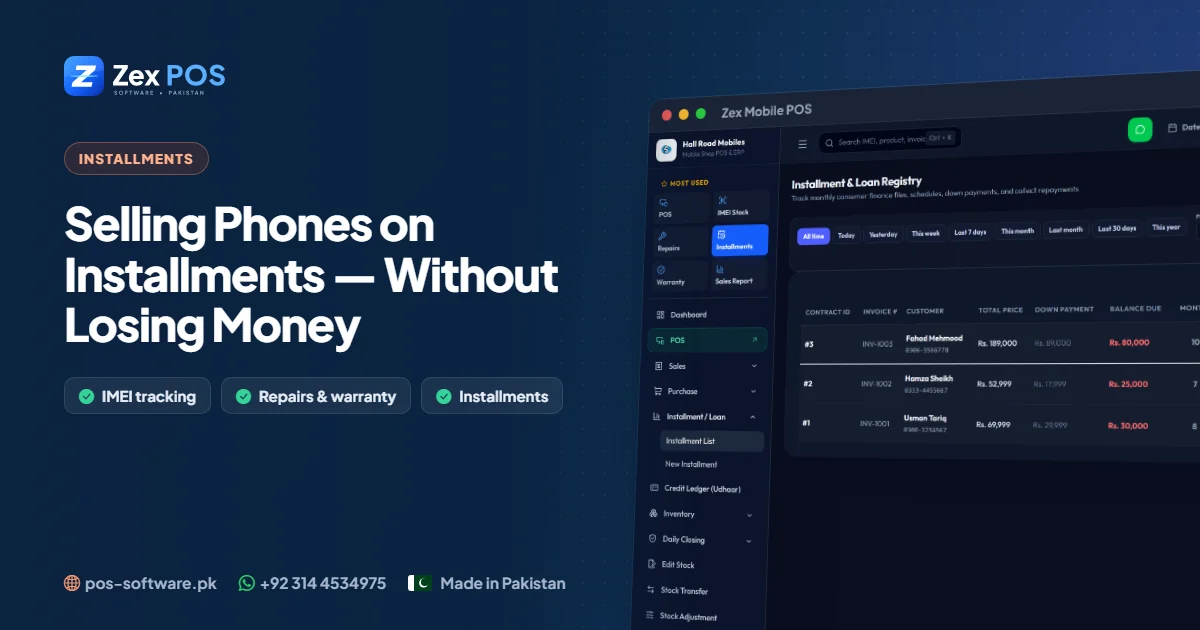
In Zex Mobile POS, an installment plan is created against the sale of the handset (with its IMEI), and records:
- The customer and their contact details
- The total price and the advance received
- The number of months and the monthly amount
- A payment schedule for each instalment
Because the handset is sold by IMEI, you always know exactly which phone belongs to which plan.
3. Give a slip for every payment
Every time the customer pays, record it and print an installment slip. The customer keeps proof, you keep a record, and there is never an argument about whether "last month" was paid. Payments can be received into cash, bank or a mobile wallet account such as JazzCash or Easypaisa, so your account balances stay correct too.
4. Review balances every week
The biggest mistake is waiting until a payment is already late. Review your installment list each week — every plan shows its balance due and its payment schedule — and send a polite reminder a few days before the next payment. Customers who are reminded early pay on time far more often.
5. Handle late payers early
- Day 1–3 late: a friendly call or WhatsApp message.
- Week 1 late: a firm reminder that mentions the agreed rule.
- Beyond: contact the guarantor and stop offering new plans to that customer.
Keep notes of each follow-up so anyone in the shop can see the history.
6. Keep installments separate from udhaar
Installment plans and ordinary credit (udhaar) are different things. Zex Mobile POS keeps a separate udhaar ledger for customers and dealers who buy on credit, so installment balances and trade credit don't get mixed up in your reports.
7. Know your real exposure
At any time, an owner should be able to answer: How much money is outstanding on installments right now? If that number grows faster than sales, tighten the policy — raise the advance or shorten the duration — before it becomes a problem.
Installment checklist
| Before the sale | After the sale |
|---|---|
| CNIC copy and phone number verified | Plan saved with advance, months and monthly amount |
| Advance received | Slip printed for every payment |
| Guarantor for larger amounts | Balances reviewed weekly |
| Rules explained to the customer | Late payers contacted within days |
Read more in our complete guide to mobile shop software, or book a free demo on WhatsApp.

Waqas Ali
Waqas ALi
My name is Waqas ali im currently working as software developer in different Field